D
In the 1960s, Douglas Engelbart, with help from his friend Bill English, invented the first computer mouse. Engelbart's invention was a simple wooden box with one button and two wheels that rolled directly on a hard surface, such as a desk. The term "mouse" came from the fact that this device (tool) had long, thin wires attached to its small body that made it look a bit like a common mouse. The name stuck and has been used ever since.
For years after Engelbart's invention, computers still relied on commands to be typed in via keyboards. It was not until computers began to use graphical user interfaces(GUIs) (图形用户界面) that mouses became popular as pointing and input devices. GUIs rely on interactions with images, rather than text commands. For example, to open a particular program, you no longer have to type a command. All you have to do is click on an icon, which is a tiny picture used to present a particular program or computer function. When pointing and clicking via GUIs became popular, computer mouses became commonplace.
Today's computers rely on highly-sophisticated GUIs that require fine motor control of a cursor (光标) on a display. There is also touch screen technology, which is used on many mobile devices, such as smart phones and tablets. Computer mouses use advanced rolling balls or lasers(激光)to translate the movement of the hand controlling the mouse into movement of the cursor on the computer display.
Many computer mouses have multiple buttons, as well as special features like wheels, to allow users to perform multiple functions at once. For example, clicking the left button of a mouse might position the cursor at a certain point within a document or web page, while clicking the right button of a mouse might bring up an in-context menu of possible actions to perform. Special features, such as wheels, can allow a user to scroll quickly up and down a web page.
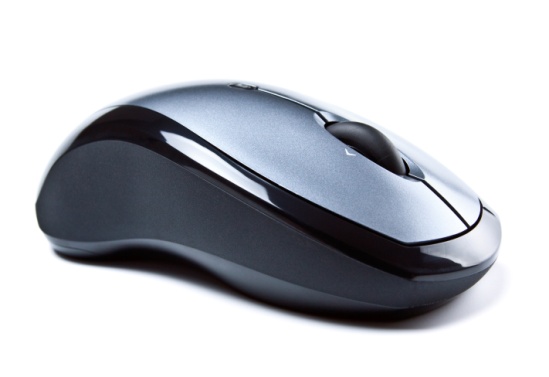 Another thing you might notice about later-model computer mouses: many of them have lost their tails! Like so many other electrical devices that have gone wireless, so have many versions of the computer mouse. Wireless mouses send data via infra-red radiation or radio waves.